( Note: Much of what you’re going to read here is opinion. I’m not a scientist. I’m not a doctor. I’m not a psychiatrist. I’m not a professional investor. I’m open to being proven wrong).
On this Easter, I keep thinking of 3 distinct quotes from history:
♠
- “All of humanity’s problems stem from man’s inability to sit quietly in a room alone.”
― Blaise Pascal,
( I think of this when we see those willfully ignoring “stay-at-home” orders, or being selectively compliant with social distancing. We think we are the center of the universe, and take selfish risks because of it. This has long been the warning of nearly every religion, ethos, and philosophy. So much of the writing of our ancestors, has clearly pointed out this recurring dilemma; maybe none better than Dante’s “Inferno” . A person while on their cell phone and driving, then taking the life of someone else while looking at text. Now, people exit their homes, potentially exposing themselves, and anyone else they come in contact with to this Coronavirus; and for what? For selfishness? Imagine taking someone else’s life by infecting them; the people then affected, when it could have easily been prevented. )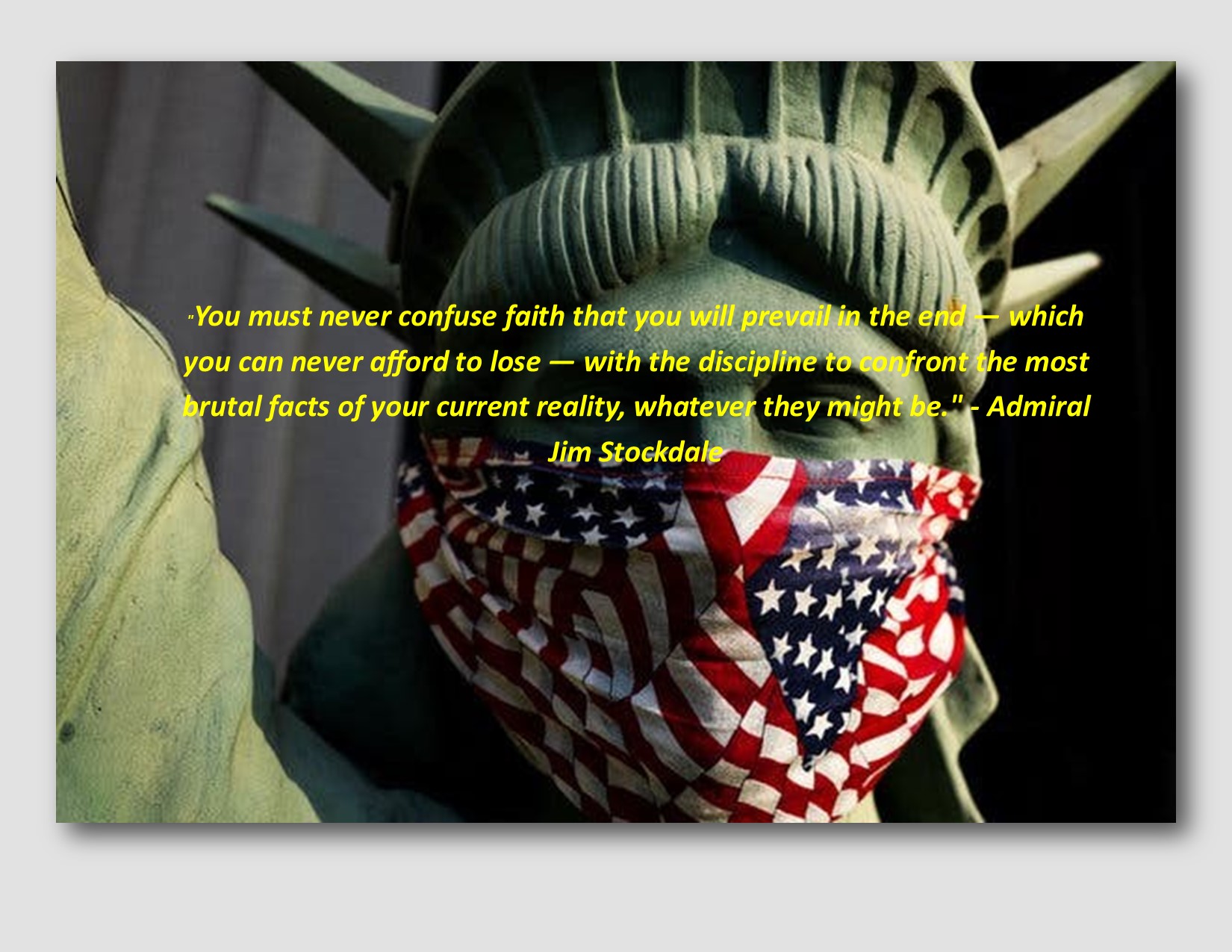
♣
- “Father, forgive them, for they do not know what they do.” – Jesus, from Luke 23:24.
( See above).
♥
- From Jim Stockdale. Explanation below:
The length of time that SARS CoV-2 and it’s resulting COVID-19, will disrupt our lives????… Well… Forever.
If that seems a bit strong, think about this: there was life BEFORE this particular Coronavirus, and there will be a way of life AFTER. It won’t be the same. It can’t be. This Coronavirus has been a Global event. One could make the argument that World War 1 or 2, were bigger events. However, there were parts of the World that went unaffected by the Wars. This virus has gripped the entire planet. This will be an open wound that will never likely completely heal. I only make this point to say to anyone ( including myself) that there won’t be a “getting back to normal.” Yes, the virus will fade, but like the generation who experienced the Great Depression, our group anxieties will be amplified. That’s not what we want, of course, it’s just how it is.
As virus’ take hold in the future, our reaction to them will be 100% different. Again, our thinking BEFORE this Coronavirus, and our thinking AFTER. There will be a particular playbook employed from all of the knowledge we’ve collected, for what will then be, “history.” When we look to history for guidance, we are shown to a method of action that will serve us well: acknowledging reality. As a collective, we can’t afford to be optimists as we move forward in fighting the virus. Let me say that again… we can’t afford to be optimists. It will kill us. However, we can’t lose faith that we will prevail, either. A paradox.
Let me explain.
For the Millions of people that read Jim Collins’ Bestseller, “Good to Great”, the person I’m about to describe will be familiar. Admiral Jim Stockdale was the Highest Ranking Prisoner of War ( POW) at the “Hanoi Hilton” during the Vietnam War. The abuse of the place was legendary. The Late Senator John McCain ended up in the same room that Jim Stockdale housed, in a hospital, whose conditions wouldn’t be tolerated in third world countries today. McCain arrived at the prison in pieces. Both of his arms broken, left shoulder shattered from a rifle butt blow from a civilian, and left leg broken. McCain, who came from a prestigious family lineage was given an opportunity that the other prisoners had not. For their reputation, the Vietnamese offered McCain a swift release. No strings attached. McCain knew how that would look. Him, abusing “privilege.” He knew what the Vietnamese were after. He saw it with clarity, despite a broken body, and refused their offer. Imagine the character and value system necessary to make a choice like that. There aren’t many humans like that today.
I digress.
Jim Stockdale, was interviewed after his release from the “Hanoi Hilton.” When asked how he made it through all of the hardships there, and why some didn’t, he said:
“Who didn’t make it out?”
“Oh, that’s easy, the optimists.”
“The optimists. Oh, they were the ones who said, ‘We’re going to be out by
Christmas.’ And Christmas would come, and Christmas would go. Then
they’d say,’We’re going to be out by Easter.’ And Easter would come, and
Easter would go. And then Thanksgiving, and then it would be Christmas
again. And they died of a broken heart.”
Stockdale was a POW there for 7 yrs. SEVEN. Imagine being tortured for seven whole years…would you lose faith? Would you lose your optimism? How long could you hold out hope?
Admiral Stockdale also said “You must never confuse faith that you will prevail in the end — which you can never afford to lose — with the discipline to confront the most brutal facts of your current reality, whatever they might be.”
In the most paradoxical way, he believed was going to get out, but chose to not only acknowledge the reality of the situation, but embrace it. How often do we do that? Are we doing it when it comes to the reality of SARS CoV-2?
Does the reality of the measures taken to combat the spread of COVID-19 suck? Yes. Can you change it? No.
Will there be long term devastation from this? Yes. What will it be? I. Don’t. Know.
We don’t know what will happen. What we can do is play out two extreme scenarios in our minds.
- Worse Case: We can’t stop the spread of the virus. Far too many people to count perish. The US defaults on it’s debt, and the economy cannot function. Desperation ensues due to hopelessness.
- This is NOT a fun one to think about. I admit. Remember, a thought exercise – NOT reality.
- Best Case: We stop the spread within a couple of weeks, and find a drug that acts as prophylaxis that somehow, doesn’t pose long-term danger to the population to which it’s administered. The 12M people that have already filed for unemployment are able to go back to work, and this registers as a very significant, but temporary “blip” in the radar.
- This scenario is also not likely.
What is the best thing we can do while we’re figuring all of this out? Acknowledge reality. Be less selfish. Evaluate what’s in our control, and do our BEST to control it.
 Andrew L Hamilton